
Commercial Invoice vs Canada Customs Invoice Made Simple
Cross-border freight can slow down fast when the paperwork doesn't match the shipment. The Commercial Invoice (CI) and the Canada Customs Invoice (CCI) may look similar, but they serve different purposes. One documents the sale. The other provides the specific data CBSA needs to assess duties and clear goods into Canada. For companies shipping to the US from Canada or receiving goods from the US, understanding the difference helps avoid delays, additional inspections, and billing issues.
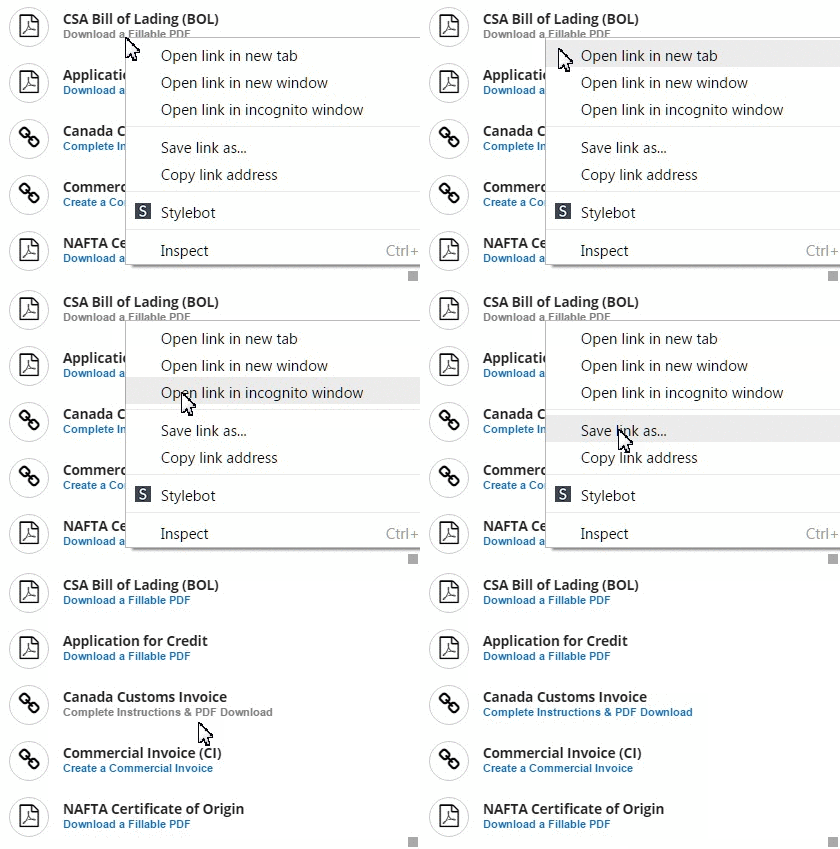
CSA Transportation provides downloadable forms and step-by-step guides for both the Commercial Invoice and the Canada Customs Invoice. If you're unsure which form you need or how to complete it, these resources walk you through every field.
Quick Navigation
At-a-Glance: CI vs CCI Comparison
Commercial Invoice (CI)
- Purpose: Sales record between buyer and seller
- Used for: All international shipments (both directions)
- Required by: US Customs (CBP) for southbound freight
- Format: No fixed format — varies by seller
- Key focus: Transaction details, pricing, payment terms
Canada Customs Invoice (CCI)
- Purpose: Customs entry document for CBSA
- Used for: Northbound shipments entering Canada
- Required by: Canada Border Services Agency (CBSA)
- Format: Standardized CBSA form with specific fields
- Key focus: Duty assessment, HS codes, country of origin
What a Commercial Invoice Includes
The Commercial Invoice is a sales document created by the seller. It records the terms of the transaction and provides both parties — and customs authorities — with the details of what was sold, to whom, and at what price.
Required Information on a Commercial Invoice
Seller & Buyer Details
Full names, addresses, and contact information for both parties. Tax IDs where applicable.
Item Descriptions
Clear description of each item, including quantity, unit price, and total value.
Invoice Number & Date
A unique invoice number and the date of sale for record-keeping and customs reference.
Payment Terms
Terms of payment (e.g., Net 30, prepaid) and the currency of the transaction.
Shipping Terms
Incoterms (FOB, CIF, etc.) indicating who is responsible for freight, insurance, and risk.
Country of Origin
Where the goods were manufactured or produced.
Practical Tip: The Commercial Invoice has no fixed format — each seller creates their own. This flexibility means critical fields are sometimes missing. Before shipping, verify that your CI includes all the information listed above. CSA provides a step-by-step Commercial Invoice guide to help you build a complete document.
What a Canada Customs Invoice Includes
The Canada Customs Invoice is a standardized form used specifically for goods entering Canada. Unlike the Commercial Invoice, the CCI has a fixed format with fields designed to give CBSA the exact data it needs to assess duties, taxes, and admissibility.
Required Information on a Canada Customs Invoice
Vendor & Consignee
Name and address of the seller (vendor) and the Canadian importer (consignee).
Country of Origin
Where the goods were manufactured. This determines applicable tariff rates and trade agreement eligibility.
HS Codes (Recommended)
Including Harmonized System codes helps CBSA classify goods faster. While the formal HS classification is completed by your customs broker on the B3-3 Coding Form, providing codes on the CCI speeds up processing.
Values & Currency
Unit price, total value, and the currency of sale — which Canadian law requires to be stated on the form.
Conditions of Sale
Shipping terms (FOB, CIF, etc.) and any conditions that affect the value — such as commissions, royalties, or assists.
Detailed Item Descriptions
Specific descriptions sufficient for CBSA to verify the goods match the declared HS codes and values.
Practical Tip: The CCI is a structured form — every field exists for a reason. Leaving fields blank or entering "N/A" when data is required can trigger a hold at the border. CSA provides a field-by-field CCI guide that explains what each section requires and how to complete it correctly.
Key Differences Between the Two Forms
Commercial Invoice = Sales Record
The CI documents the transaction between buyer and seller. It focuses on pricing, payment terms, and what was sold. It serves as the primary record for accounting, tax purposes, and as proof of the sale.
The CI has no standardized format — each seller creates their own version, which means required customs fields are sometimes missing.
Canada Customs Invoice = Customs Entry Support
The CCI provides CBSA with the specific data needed to assess duties and clear goods into Canada. It includes fields for HS codes, country of origin, and currency of sale that the CI may not contain.
The CCI uses a standardized CBSA format — ensuring all required fields are present and consistently structured for customs processing.
Can a Commercial Invoice Replace a Canada Customs Invoice?
In some cases, CBSA will accept a Commercial Invoice in place of a CCI — but only if it contains all the required fields. This includes the currency of sale, country of origin, HS codes, and detailed item descriptions.
Important: Relying on a Commercial Invoice alone increases the risk that a required field is missing — since the CI has no fixed format. Using the standardized CCI form ensures all CBSA-required data is present and reduces the chance of a hold at the border. When in doubt, submit both.
When to Use Each Invoice
Direction Determines the Form
Northbound (USA → Canada)
Required: Canada Customs Invoice (CCI)
The CCI is the primary customs document for goods entering Canada. A Commercial Invoice should also accompany the shipment as a supporting sales record.
Southbound (Canada → USA)
Required: Commercial Invoice (CI)
US Customs and Border Protection (CBP) uses the Commercial Invoice as the primary customs document. The CCI is not required for US-bound freight.
Practical Tip: If you ship in both directions, maintain templates for both forms. Keep a completed CCI template for your regular northbound products and a CI template for southbound — pre-filled with your company details, standard item descriptions, and HS codes. This reduces errors and speeds up document preparation for each shipment.
Errors That Cause Border Delays
Documentation errors are one of the most common reasons for shipment holds at the Canada-USA border. Most are preventable with a simple review before the freight leaves your facility.
Missing or Incomplete Information
- Missing currency of sale — Canadian law requires this on the CCI. Omitting it can trigger a hold.
- Vague item descriptions — "Goods" or "Parts" is not sufficient. Customs needs specific descriptions to match against HS codes.
- Missing HS codes — Without these, CBSA cannot assess the correct duty rate and may delay the shipment for classification.
- Blank fields on the CCI — Every field on the standardized form exists for a reason. Leaving them blank signals incomplete documentation.
Mismatched Data Across Documents
- Different values on CI vs CCI — If the declared value doesn't match between forms, customs will question the shipment.
- Inconsistent item descriptions — Descriptions must match across the BOL, CI, and CCI. Different wording for the same item causes confusion.
- Quantity mismatches — If the CI says 10 units and the CCI says 12, the shipment will be held for clarification.
- Different shipping terms — FOB on one form and CIF on another changes who is responsible for costs — and affects the declared value.
Pre-Shipment Documentation Checklist
Before your shipment leaves the facility, verify the following across all documents (BOL, CI, CCI):
- Item descriptions match on all forms
- Declared values are consistent
- Quantities align across all documents
- Currency of sale is stated (required for CCI)
- HS codes are present and correct
- Country of origin is listed
- Shipping terms (Incoterms) are consistent
- Seller and buyer details are complete on both forms
For full details on required documentation and downloadable forms, visit CSA's Customs & Cross Border Shipping resource page.
Frequently Asked Questions
A Commercial Invoice (CI) is a sales record between buyer and seller that documents the transaction — including item descriptions, prices, and payment terms. A Canada Customs Invoice (CCI) is a customs-specific form that provides the Canada Border Services Agency (CBSA) with the data needed to assess duties and taxes, including HS codes, country of origin, and currency of sale. Both are typically required for cross-border shipments entering Canada.
In some cases, CBSA will accept a Commercial Invoice in place of a Canada Customs Invoice — provided it contains all the required fields, including currency of sale, country of origin, and a full description of goods. However, using the standardized CCI form ensures all CBSA-required fields are present and reduces the risk of delays caused by missing information.
For northbound shipments entering Canada, a Canada Customs Invoice (CCI) is typically required. The Commercial Invoice may also be submitted as a supporting sales record. For southbound shipments entering the United States, a Commercial Invoice is the primary customs document — the CCI is not required for US-bound freight.
Mismatched data between shipping documents is one of the most common causes of border delays. If the declared values, item descriptions, or quantities differ between the CI and CCI, customs may hold the shipment for review, request additional documentation, or reassess duties. Always verify that all shipping documents are consistent before the shipment leaves your facility.
A Canada Customs Invoice must include: seller and buyer names and addresses, country of origin, detailed description of goods, Harmonized System (HS) codes, unit price and total value, currency of sale, shipping terms (FOB, CIF, etc.), and conditions of sale.
Canadian law requires the currency of sale to be stated on the form. CSA provides a field-by-field CCI completion guide to help you get every section right.
Yes. CSA Transportation operates as a customs coordinator and provides downloadable CI and CCI forms, along with step-by-step guides for completing them. CSA's in-house customs coordinators verify that documentation is complete and coordinate with your customs broker before shipments reach the border, helping to catch errors and reduce delays.
For all required forms and instructions, visit our Customs & Cross Border Shipping resource page.
Get Help With Your Cross-Border Documentation
Clear customs paperwork keeps shipments moving and eliminates avoidable delays. Whether you need help completing a CCI, verifying your Commercial Invoice, or preparing your full documentation package for cross-border LTL freight, CSA Transportation is here to help.
Why CSA Transportation
CSA Transportation provides customs coordination services backed by PIP-accredited, customs-bonded terminal facilities. Our in-house customs coordinators work with your customs broker to ensure your documentation is complete and consistent before your freight reaches the border.
Downloadable Forms
CI, CCI, BOL templates with completion guides
Customs Coordinators
Coordinators verify docs & liaise with your broker
PIP Accredited
Trusted Trader status with CBSA
Bonded Facilities
In-bond safety net when paperwork issues arise
Ready to Ship Cross-Border?
Whether you're preparing your first cross-border shipment or streamlining documentation for regular lanes between Canada and the USA, our team can help ensure your invoices are accurate and your freight clears customs without delays.
Or call us: (416) 754-0999
Author

Matt enjoys exploring creative ways to connect people through marketing, with a particular passion for sales, marketing automation, and AI. At CSA Transportation, he works on branding, content strategy, automation, SEO and campaigns that help tell CSA's story. From website updates to email designs, Matt brings ideas to life while keeping the bigger picture in mind.